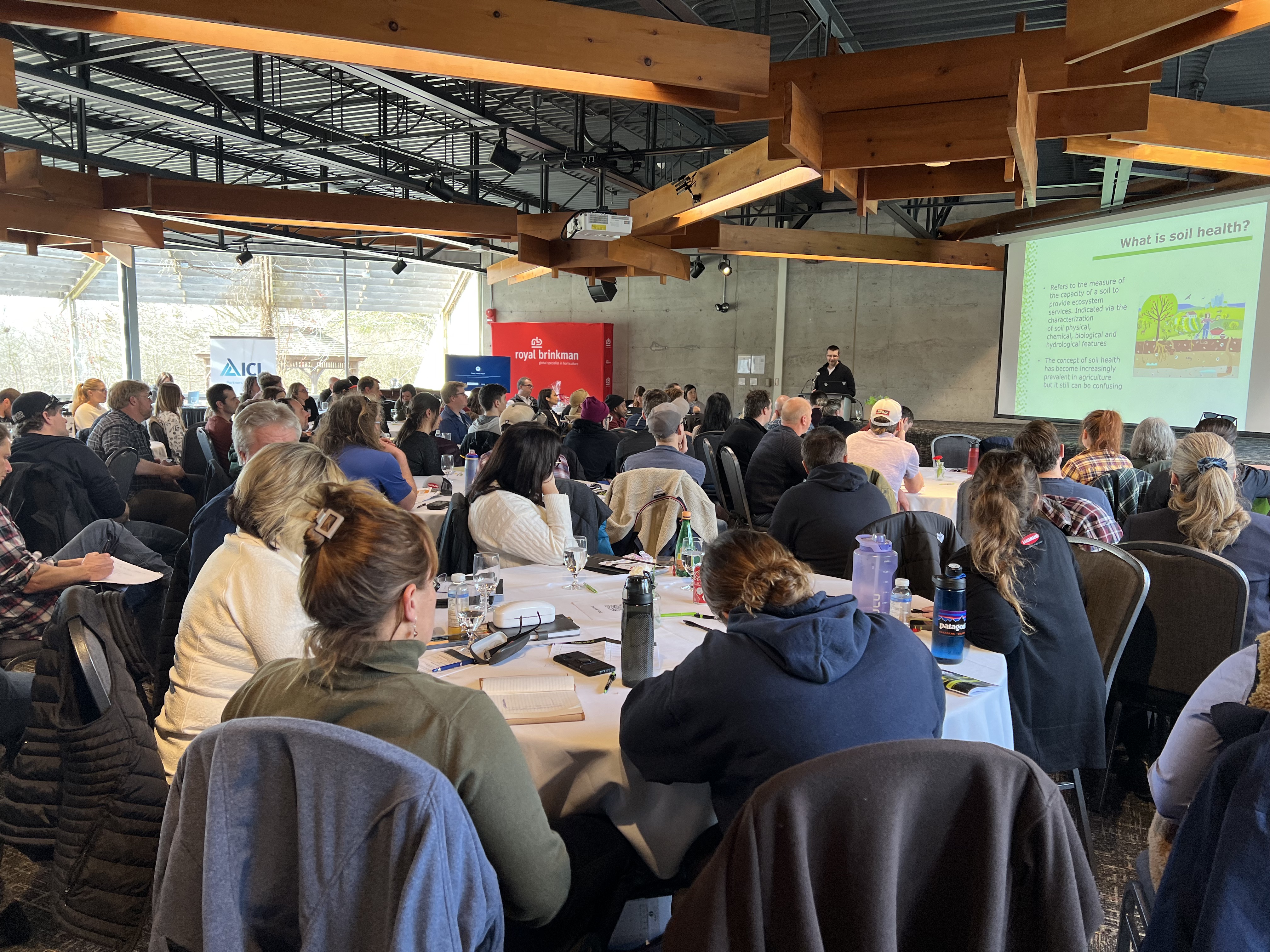
What an amazing turnout we had at the Nursery Growers Short course on February 7th. The event sold out in record-time and we had a packed venue.
For those who couldn’t make it (or those who maybe accidentally dozed off into a food coma after the delicious and filling lunch) I wanted to share some of what I thought were key highlights and take-home messages from each of our speakers.
- Grower Updates
- Business principles & Opportunities for growth
- Grower Session: Tips, Trails, Tribulations and More!
- Soil & Media Talks
- New Technologies and Innovations
- Some quotes to leave you with…
Before I go on, I want to acknowledge the valuable contributions from the growers on the short course planning committee; John Mantel and Ryan Munroe, and all the support from Landscape Ontario to run this annual event – especially Jeanine West and Lauralee Gonzales. And of course, the sponsors for the event (Royal Brinkman, Plant Products, ICL Fertilizers, Lallemand Plant Care, Gro-Bark, A.M.A horticulture, and Berger) without our sponsors we would not be able to bring in out of province speakers and host such a successful education and networking event!
Grower Updates
Following long-standing traditions, I opened our day by providing some need-to-know updates related to:
- Spotted Lanternfly: it’s coming, are you ready?
- Nursery scout program and what we came across last season
- Upcoming IPM Workshops for growers (Feb 27-29) – Register here
- Funding opportunities currently open such as the Agri-Tech Innovation Initiative and the Biosecurity Enhancement Initiative
- Other digital projects in the works such as the OMAFRA Crop Protection Hub
We then heard from Jeanine West, the LO Grower Technical Analysist as she reviewed a number of additional updated relevant to growers including:
- Revitalization of the Growers Group
- Trade updates on BTM, SLF, and black stem rust
- Boxwood: current BTM regulation area consultation, as well as what is allowed to be shipped and where.
- MRNF’s Invasive Species Act that was updated on January 1st:
- Unfortunately, the whole genus of Salvinia (including S. rotundifolia) is prohibited to propagate or sell
- See the MNRF website for a full list of regulated plants (https://news.ontario.ca/en/backgrounder/1003960/ontario-designates-new-invasive-species )
- An update on the Protected Ag Stewardship regarding users of Greenhouse labeled protect.
Business principles & Opportunities for growth
Charlene Williams from Vineland Research and Innovation Centre presented on building nursery-municipal partnerships.
- Charlene discussed the Greening the landscape consortium – a collaborative member-driven research network and discussions this group had in terms of opportunities for building nursery-municipal partnerships. A number of nurseries are already a part of this group and have added valuable input to the consortium.
- She also left us all with a good takeaway question in terms of what opportunities nurseries see: What are some clear actions that you believe could be readily implemented by nurseries to strengthen communication and collaboration as it related to the sourcing and procurement of trees for urban plantings?
Tyler Hoskins, Head of Research and Development at Robinson Nursery in Oregon was one of our two keynote speakers and gave two talks over the day on how Robinson Nursery is trying to improve both how they grow plants, but also leaders in the industry.
Tyler’s first talk shared why it’s important to invest in professional development and some of the internal processes they have put into place to help identify growth opportunities and mentoring.
- While it does require some investment in time, Tyler highlighted that when you have a capable team with similar values and goals working together to share those responsibilities – the time is worth it.
- Tyler also shared how they are empowering staff to take on initiatives such as their NEXGEN program to promote young people entering the industry.
Grower Session: Tips, Trails, Tribulations and More!
After a quick break for coffee and chit chats, we had an exciting session of Grower Talks.
Alex and Mark Verbinnen kicked off the session with their talk: Trials, Tips and Techniques from the Verbinnen’s Nursery Team. Alex and Mark presented a number of new/innovative practices at the farm including:
- How they worked to manage iron deficiency issues in Pinus strobus,
- What they did to improve caliper to height ratios and reduce the need for staking plants,
- Showcased some neat videos of a new tool they developed for cutting back plants and the labour savings associated with it, and
- A discussion on the new ‘Erfgoed Floors’ they had installed with a breakdown of the benefits and costs of the system.
We then heard from two growers at NVK Nurseries: Lucas Kampen and Nolan Togeretz who shared some successes and failures of 2023. As part of their talk, they walked us through different production styles and techniques at NVK and outlined key steps they take at planting, how they approach fertilizing in field and containers, water management and the importance of water quality, and their weed management motto of start clean and stay clean. Lastly, they touched on how important the people who do it all are and how each staff are inspired to treat the nursery as their own.
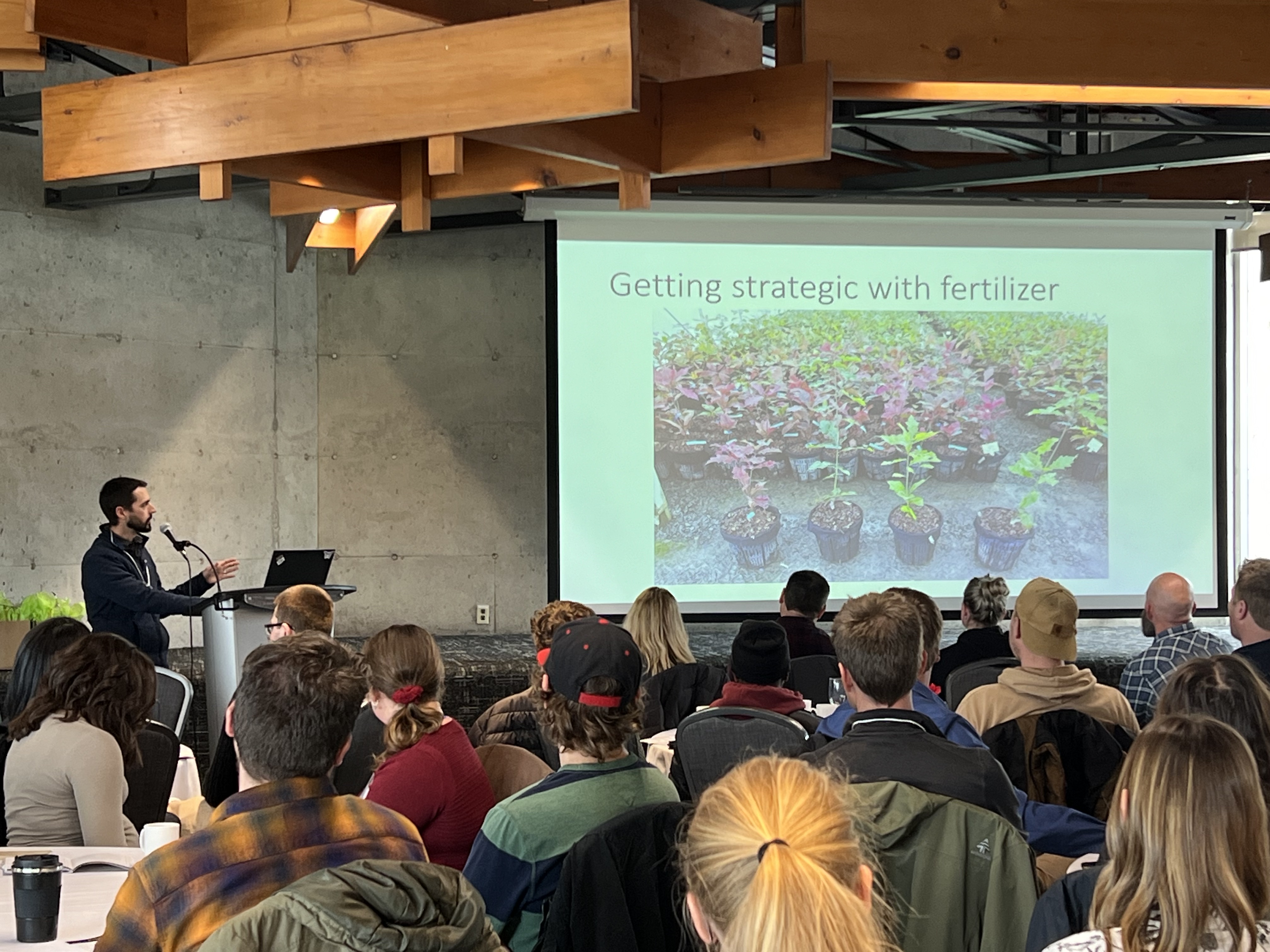
To close off our Grower Talks, Tyler Hoskins gave his second talk of the day on the Trials and Tribulations experienced at Robison Nursery. This was an info-packed talk as Tyler outlined some research and development projects they have going in their propagation, field and container departments including: results of fertilizer trials, interesting results from trialing red shade fabric, and the less than desirable results they got when they tried to use Ellepot paper as row covers… Spoiler alert, that didn’t work!
Tyler explained that his guiding principles when doing R&D are always:
- Track your defects,
- Let the dollars guide the projects, and
- Feed the Value chain: for the customer, the company, and goodwill
Soil & Media Talks
After a break for lunch and a chance for everyone to enjoy the beautiful sunny day and stretch their legs with a walk around the arboretum, we kicked off the afternoon with some talks on media and soil.
The other keynote of the day was Dr. Jim Owen from USDA-ARS based in Wooster Ohio. Jim presented various techniques on how to get the most for your dollar out of your substrate, irrigation, and fertilizer. He presented lots of data and visuals to help conceptualize water distribution post-irrigation and built upon that to talk about optimizing fertilizer placement and stratified substrates, as well as showing where you’re losing nutrients like Nitrogen and Phosphorus. Jim provided a lot of information in his talk but one impactful statement was: “sometimes you need to let the plant work for it”. This theme definitely came through in some other talks throughout the day as well.
Jason Henry from Vineland Research and Innovation Centre then spoke on soil health and what are some of the key soil properties to assess, how they’re measured in a lab, and what they mean. He outlined some common soil health packages available but indicated consistency is key, once you chose one, stick with it! He also clarified that soil health is distinctly different to soil fertility. Soil health treats the soil as a living system which benefits from practices such as integrating cover crops, diversifying rotations, and reducing tillage and compaction as much as possible.
The last of our soil talks was from OMAFRA’s soil management specialist, Jake Munroe. While Jake’s professional focus has been with cover crops in field crop rotations, he took some time to show the resources available, such as the Midwest Cover Crops Council selector tool, that field nursery growers can take advantage of. Jake then walked us through a cover cropping scenario using fallowed land of how to make selections for cover crops based on the goals of the grower including:
- how to select which species to seed,
- choosing a seeding strategy,
- planning your termination, and
- how to evaluate success.
His main takeaway for the group was “Cover cropping does not need to be complicated. Match your management to your goals and keep it simple.”
New Technologies and Innovations
Our last two speakers of the day focused on innovations and new technologies.
We first heard from David Weales, research assistant at the Robotics Institute at the University of Guelph where for the past number of years, he and Dr. Medhat Moussa have been conducting field trials of a 3D vision learning model to measure the caliper of nursery trees and catalogue this data for inventory management. Using a specialized camera attached to a truck, tractor or even pulled by a wagon, the model can automate the measurement process helping to reduce labour and allow for review of nursery stock digitally. David walked us through the challenge of measuring caliper when trees have bamboo stakes, but also how they trained the model to recognize this issue. It goes to show that measuring other things like tree height would absolutely be possible for the future with additional cameras. This technology is not yet available for growers to purchase but the team is looking into avenues to bring this new technology to the market.
For the last presentation of the day, Rodney Bierhuizen from Sunrise Greenhouses captivated audiences with numerous videos showing the innovative technologies they’ve either purchased or built and put to work at their floriculture greenhouse. One of the robots he showcased for propagation and sticking was funded through the last round of Agri-Tech Innovation funding which enabled them to move 7 staff to other tasks. This was the ISO cutting planter which he said was “the best piece of equipment we’ve ever purchased” that can do 2200 cuttings in an hour. He also described other technologies they’ve adopted in their greenhouse including an automated cleaning process for benches, a Flex sorter for ultra-high speed grading, their automated rolling bench system, a Javo spacing robot, an Indexing trimmer by BOLD robotics solutions, and others. One of Rodney’s take-home messages for the group was to consider what new technology might work at your farm in the future. With the way AI and technology is heading, do you think there’s a task that humanoid robots could do within the next 10 years? He also mentioned that there are opportunities to purchase used equipment from Europe and also stressed the importance of leveraging government programs.
As a reminder, the Agri-tech Innovation Initiative that Rodney referenced just opened another intake and is currently accepting proposals until March 28th, 2024.
Some quotes to leave you with…
All in all, it was an information packed day! If I had to some up some key themes from the day, I’d say these few quotes do a good job, …
“Trials can pay for themselves”
“Trying new things (like cover cropping) doesn’t need to be complicated – make sure you consider your goals first”
“Invest in your staff – make them think like an owner”
“Make your plants work for it a little… sometimes that goes for people too!”
Thank you again to all who attended or were involved in the 2024 Nursery Growers Short Course – I know not all the topics are always relevant to every nursery (what a diverse sector we have!) but I do always like to hear your feedback and suggestions to improve. If you have thoughts, you’d like to share please reach out to me anytime: cassie.russell@ontario.ca