Elm zigzag sawfly (Aproceros leucopoda) is an invasive forestry pest from Asia that can cause defoliation of elm trees (Ulmus spp).
The first report of Elm zigzag sawfly (EZS) in North America was in July of 2020, by an iNaturalist observation in Sainte-Martine Quebec and was later confirmed by the Canadian Food Inspection Agency. It’s unclear how it arrived here, but for the last number of years, it has been naturally spreading westward into Southern Ontario, as well as other states and provinces, and causing significant defoliation in some areas.
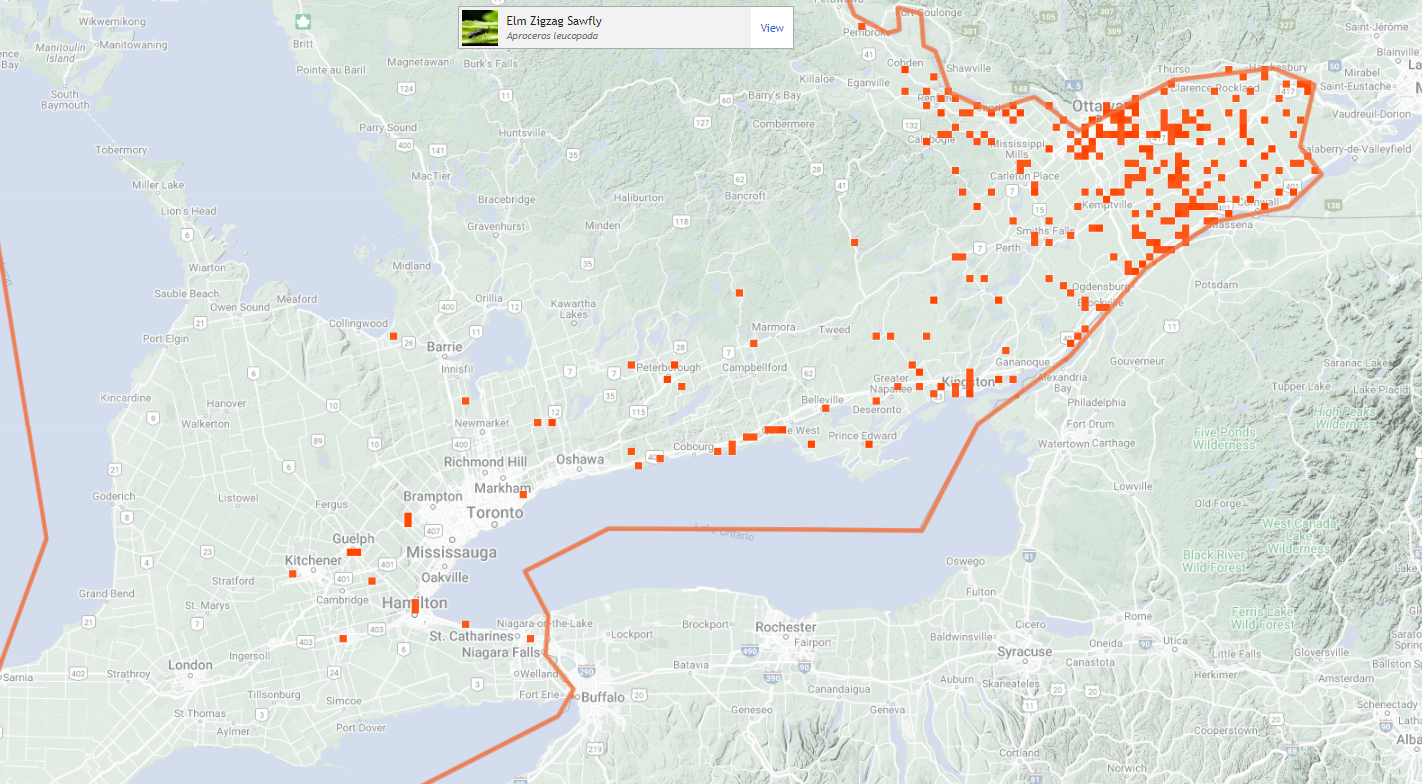
Distribution in Ontario
As of early summer 2024, EZS has been positively identified on iNaturalist as far west as Kitchener Ontario, and as far North as Pembroke, Ontario. Sightings around the southern border of Ontario and Quebec are the most abundant, and presence has been identified in other provinces and states including Quebec, Vermont, New York, Pennsylvania, Ohio, North Carolina, Massachusetts and Maryland.
Biology
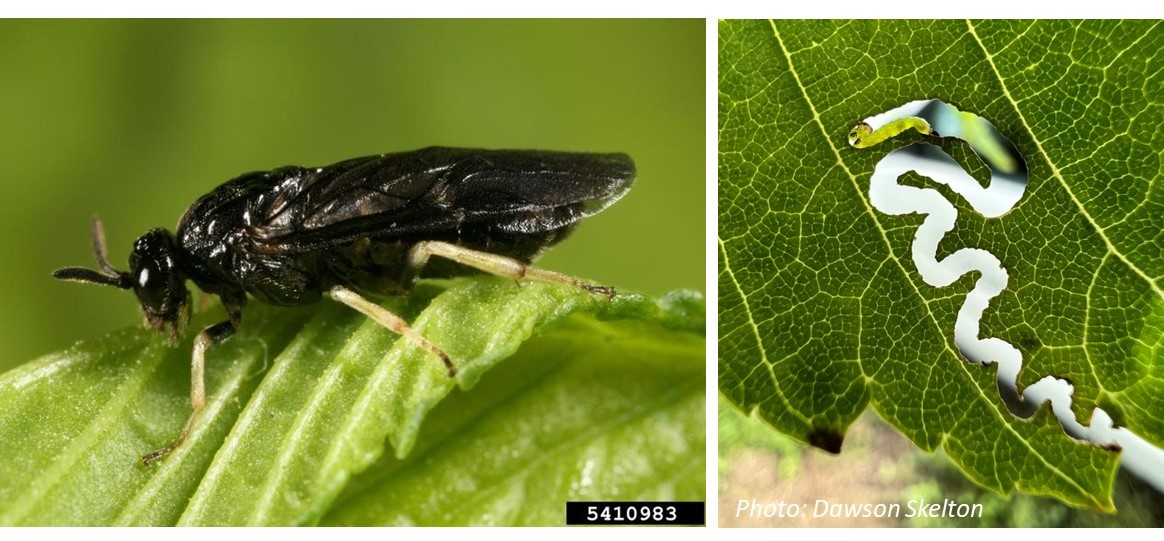
This sawfly belongs to the family Argidae (Order: Hymenoptera) and gets its common name from its characteristic “zigzag” feeding pattern on elm leaves. The adults of this species are 6-7 mm long, shiny black wasps that have been reported to fly up to 90 km a year. This species reproduces asexually without the fertilization of a male through a process known as parthenogenesis. They can produce up to four overlapping generations per year in Asia, but have been observed to produce six generations in Europe. Adult females can lay eggs as soon as they emerge and can lay 7-48 eggs on the serrated leaf margins of elm leaves.
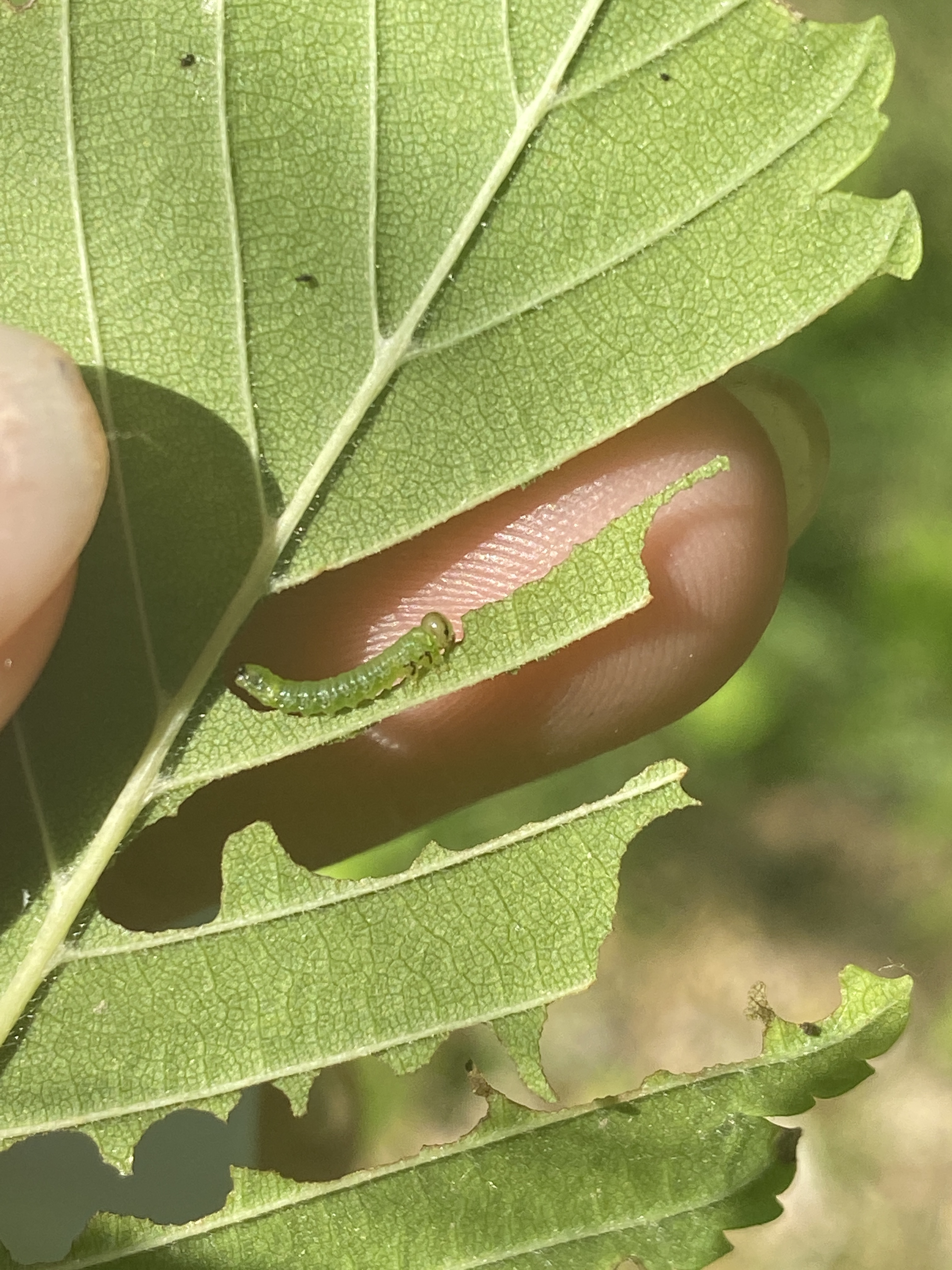
Larvae emerge after 4-8 days and go through six instars over 15-18 days by feeding on elm leaves. The larvae are the damaging stage of this pest. The larvae resemble small green caterpillars with an oval head capsule and feed directly on the leaves. The larvae range in size from 1.8 mm long by 0.3 mm wide as early instars and grow to 10 – 11 mm long by 1.4 – 1.5 mm wide before they pupate.
Once they’ve progressed through their six instars and feeding is complete, the sawfly begins to spin a cocoon and it will pupate inside until the adult fly emerges 4-7 days later. Summer cocoons are recognizable by their light net-like protective structure that is attached to the underside of leaves, branches, or shoots. This net like structure protects the pupae inside which starts green and turns to black before the adult emerges. To emerge, the adult fly chews a small hole in the net-like structure, leaving most of the structure in tact and behind as a sign the pest was present.
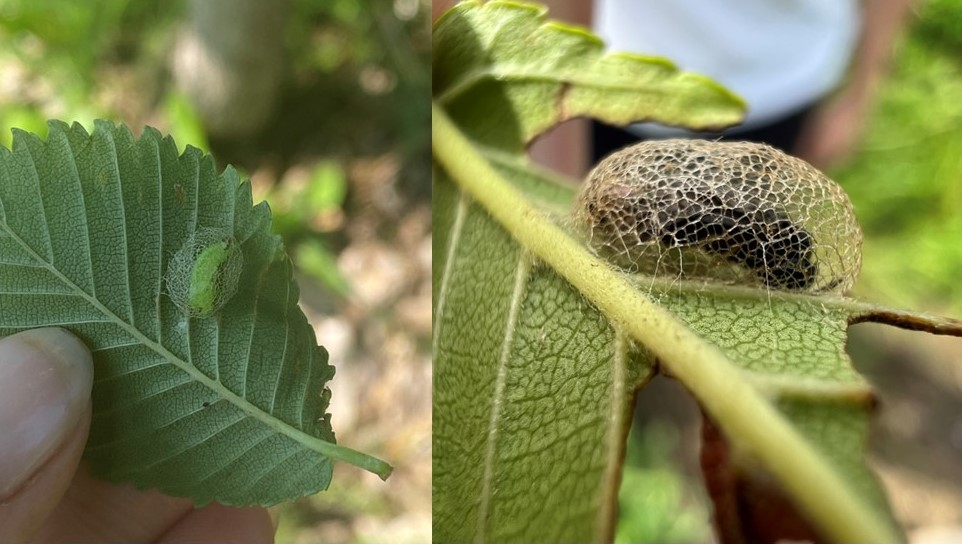
The pest overwinters in it’s pupal stage and forms a different kind of cocoon that is more dense and found underneath organic material on the ground and emerge as adults the following spring.
Signs and Symptoms
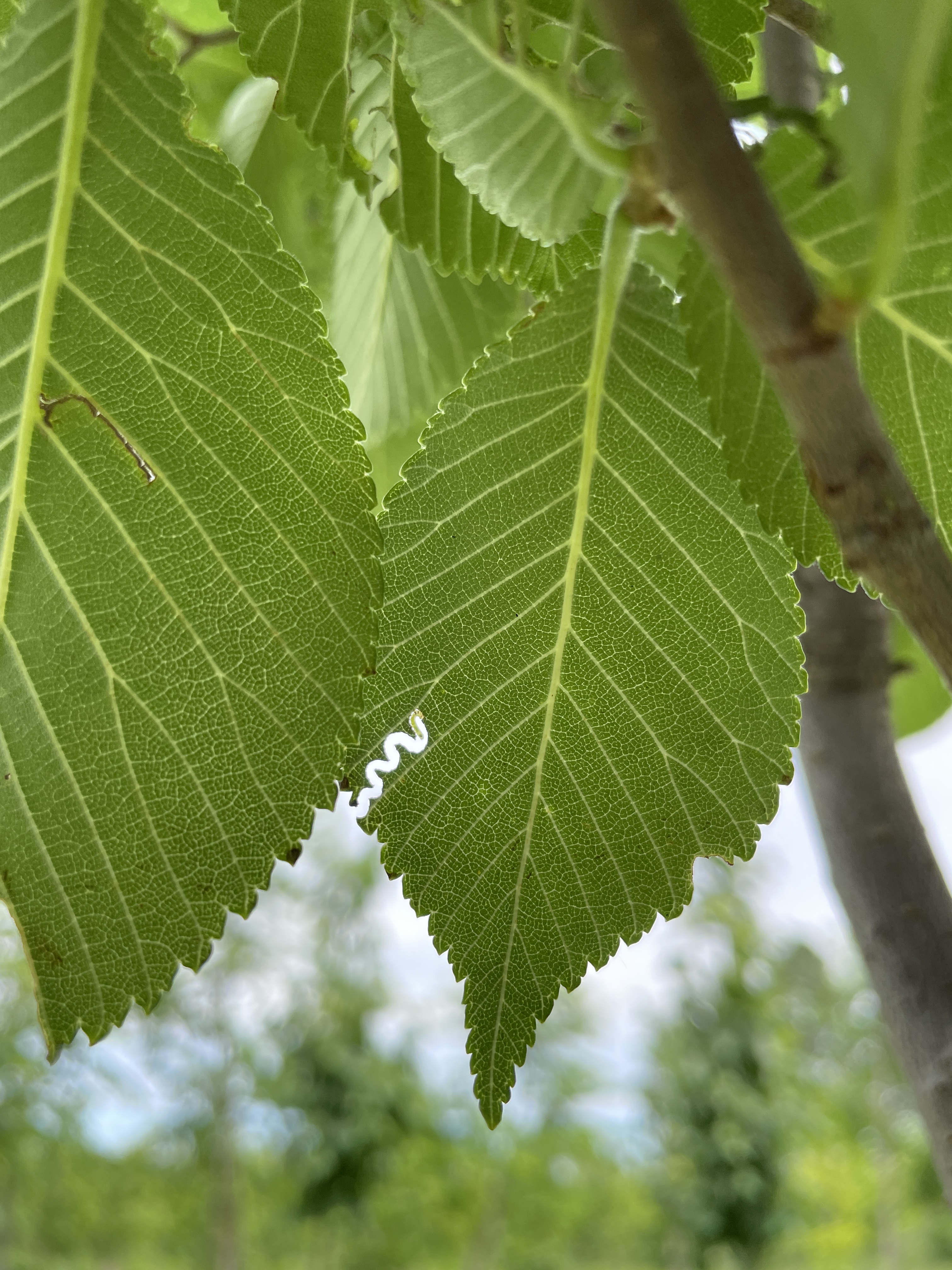
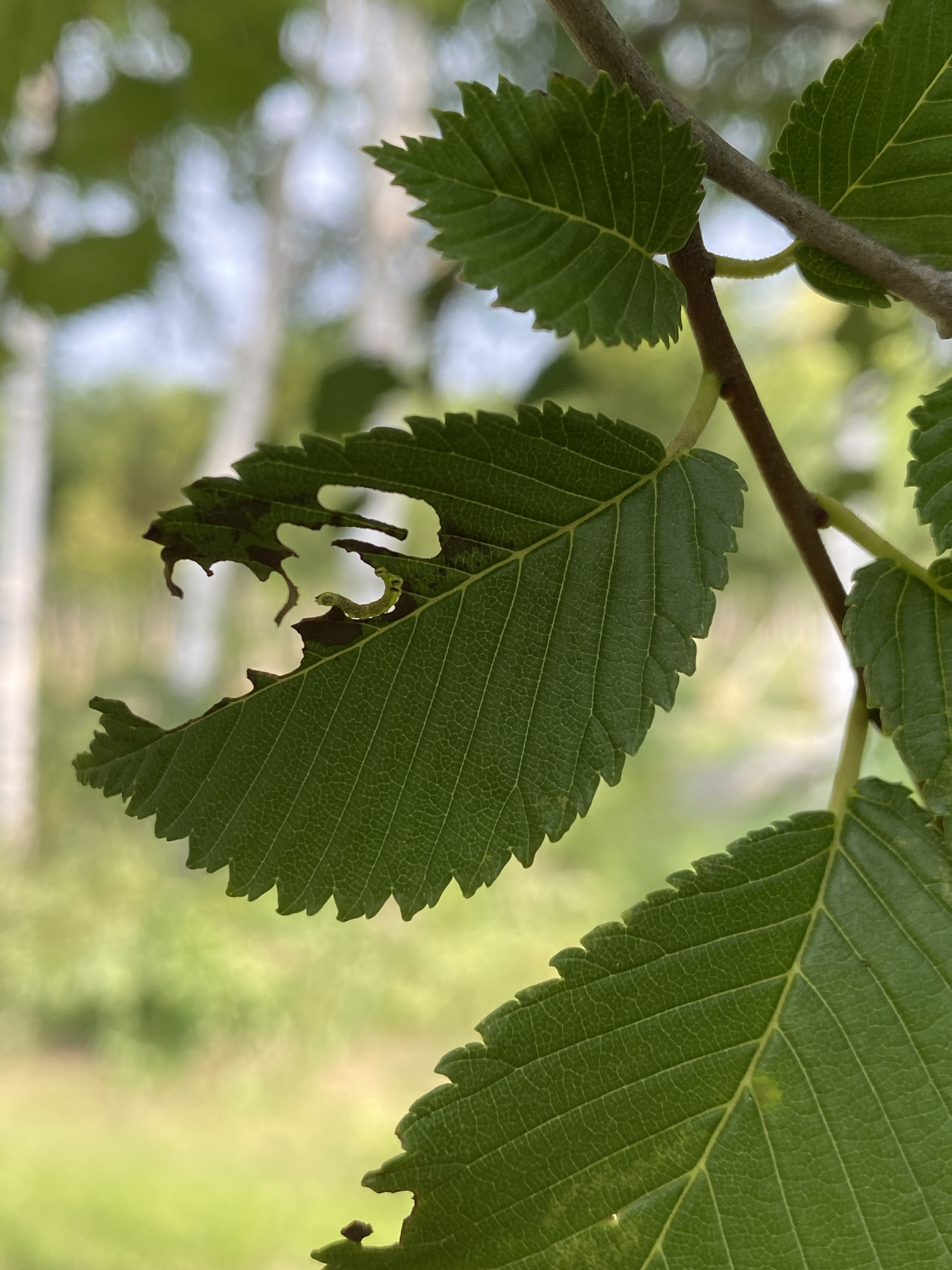
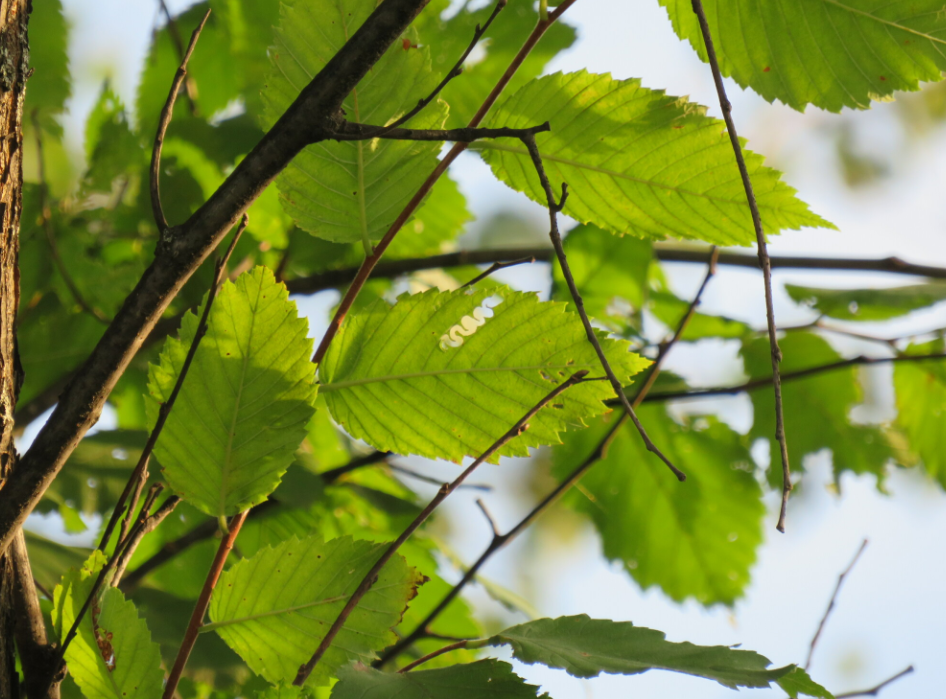
The “zigzag” pattern of feeding damage on elm leaves is a diagnostic indicator of larvae which are present from early May to October in Ontario. Smaller larvae feed within in the veins of a leaf, weaving back and forth. The small green larvae can usually be found at the end of the feeding channel. As the larvae mature and continue to feed, the distinctive zigzag damage can be obscured by overfeeding and can also be confused with the damage produced by leaf miners or other foliage feeding insects like japanese beetles or pale green weevils that frequent Ulmus host plants. The presence of the protective pupal structure is also a diagnostic sign of EZS.
Impacts and Management
EZS can cause moderate to significant damage to elm trees and compete with native elm feeding insects. Additionally, these sawflies can put further pressure on elm trees that may suffer from other issues like Dutch elm disease. In Europe where infestations of the sawfly have been widespread, elms that were suffering from Dutch elm disease were seeing defoliation rates of 74-90%.
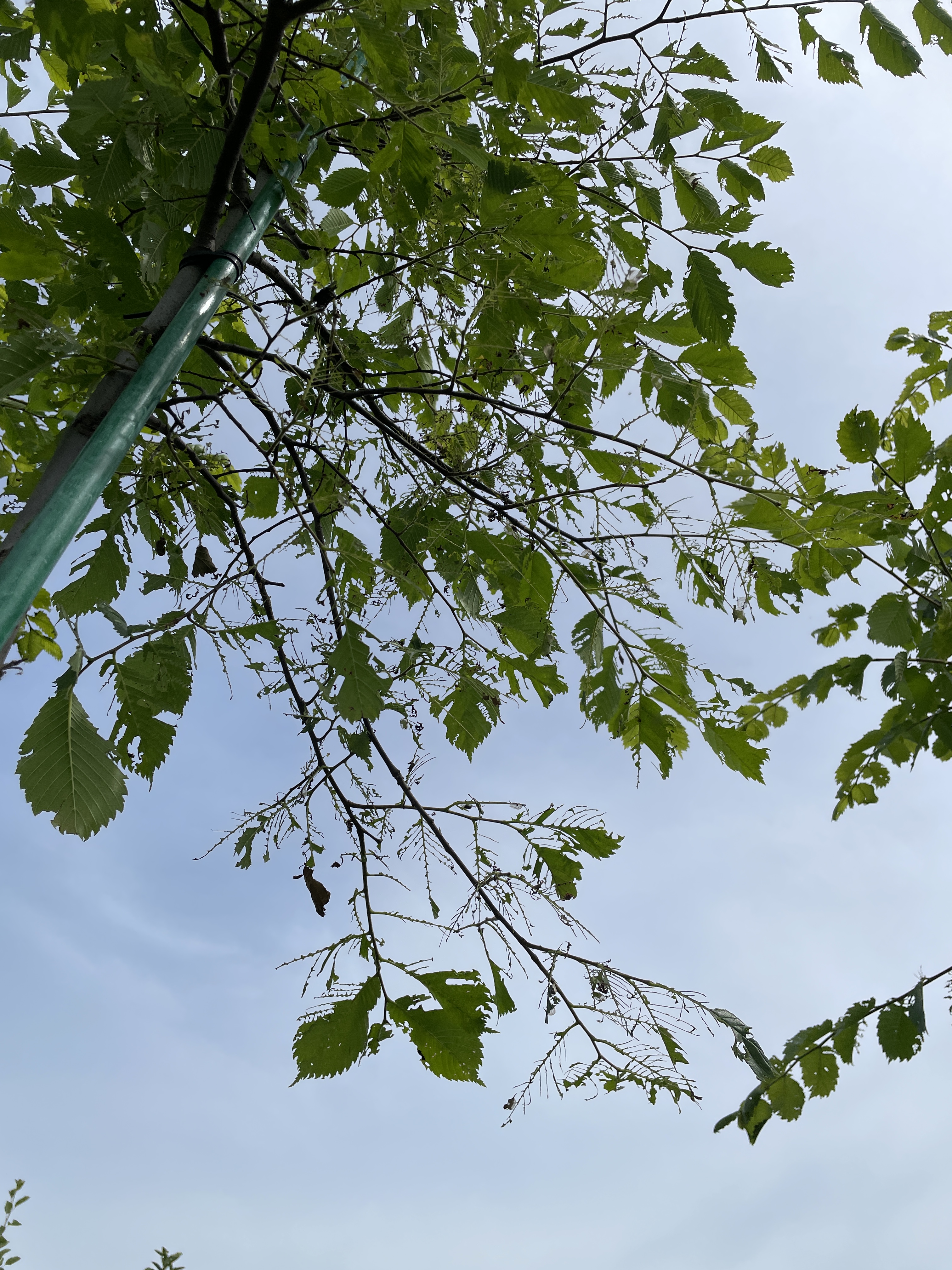
In Ontario, especially towards the Ottawa region, significant defoliation on Ulmus americana has been observed after repeated years of feeding damage. Other ulmus species can also be fed upon. In other regions, landscape trees have not sustained enough defoliation to significantly impact plant health. However, as we are still in the early stages of this pest’s arrival and range expansion, we cannot say for certain how impactful this non-native pest will be on our native elms.
Currently, the most important management strategy is to monitor for presence and limit distribution. Limiting the movement of firewood and infested elm material is essential to slowing the spread of this pest. Physical removal through hand picking or water spraying may also be an effective strategy at this time when populations are low.
In a nursery setting with monocultures of young elm trees, chemical intervention may be necessary as populations of EZS can grow rapidly and significantly impact plant health due to defoliation. Open feeding sawflies can often be controlled or suppressed by regular IPM programs that include chemistries like insecticidal soap, Success (group 5) or Pounce (group 3) which are already labeled for sawflies in ornamentals. Targeting sprays when you start to see the small zig zag feeding channels is ideal; before the larvae have a chance to do significant feeding damage and pupate. Remember, these pests do not need to mate and instead reproduce asexually, so populations can grow quite rapidly.
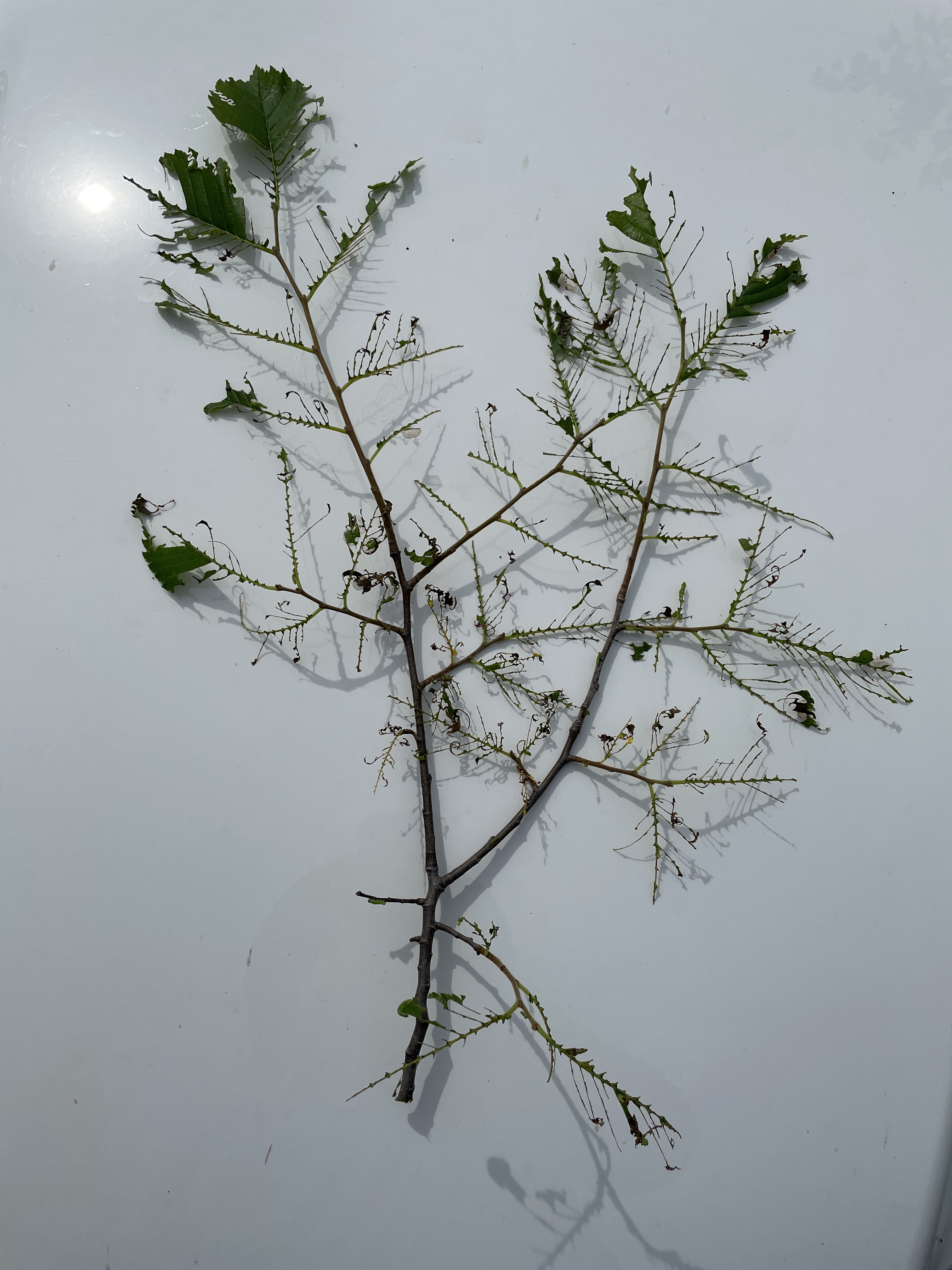
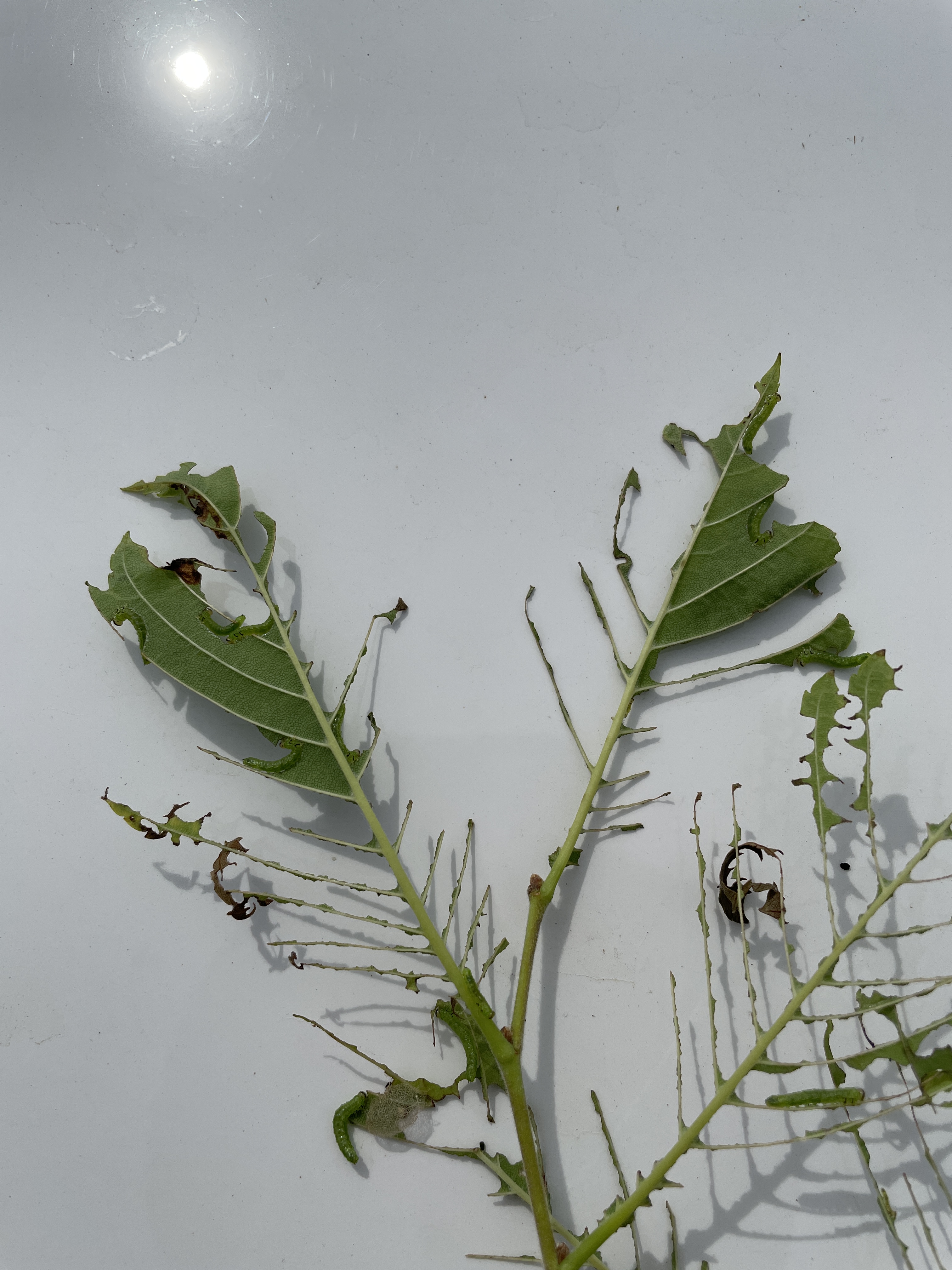
While EZS larvae may look like caterpillars feeding on leaves, it’s important to note that sawflies are NOT in the Lepidoptera family (butterflies and moths) and therefore, BTK products such as Dipel do NOT work to control sawfly larva.
What can I do?
We still have much to learn about this pest here in Southern Ontario, including it’s period of activity and range as it continues to spread. One way to help us gather information is to report EZS on public portals like iNaturalist. It helps to take photos of the leaves and damage observed but also photos of the whole tree to show the proportion of damaged leaves.
While EZS is an invasive species, it is not a regulated pest in Canada. If you are noticing significant damage due to EZS you can you can either contact the Invading Species Awareness Hotline at 1-800-563-7711, or send a photo with the location of the sighting to the Canadian Food Inspection Agency at Surveillance@inspection.gc.ca.
For more information, you can visit the following resources:
- Invasive Species Centre: https://www.invasivespeciescentre.ca/invasive-species/meet-the-species/invasive-insects/elm-zigzag-sawfly/
- Government of Canada – Aproceros leucopoda Takeuchi – (EZS) – Fact sheet: https://inspection.canada.ca/plant-health/invasive-species/insects/elm-zigzag-sawfly/fact-sheet/eng/1599690785672/1599690786222
- Trees Canadensis – Citizen Science Tracks Elm Zigzag Sawfly: https://treescanadensis.ca/citizen-science-tracks-elm-zigzag-sawfly/
- Elm zigzag sawfly, Aproceros leucopoda (Hymenoptera: Argidae), recorded for the first time in North America through community science : https://www.cambridge.org/core/journals/canadian-entomologist/article/elm-zigzag-sawfly-aproceros-leucopoda-hymenoptera-argidae-recorded-for-the-first-time-in-north-america-through-community-science/4A5DAE3501F860B529AF848738842180
- SLELO PRISM: https://www.sleloinvasives.org/invasives/tiered-species-list/elm-zigzag-sawfly/
- UMASS Extension: https://ag.umass.edu/landscape/fact-sheets/elm-zigzag-sawfly


Any impacts seen on Hackberry yet?
LikeLike
none yet, just Ulmus.
LikeLike